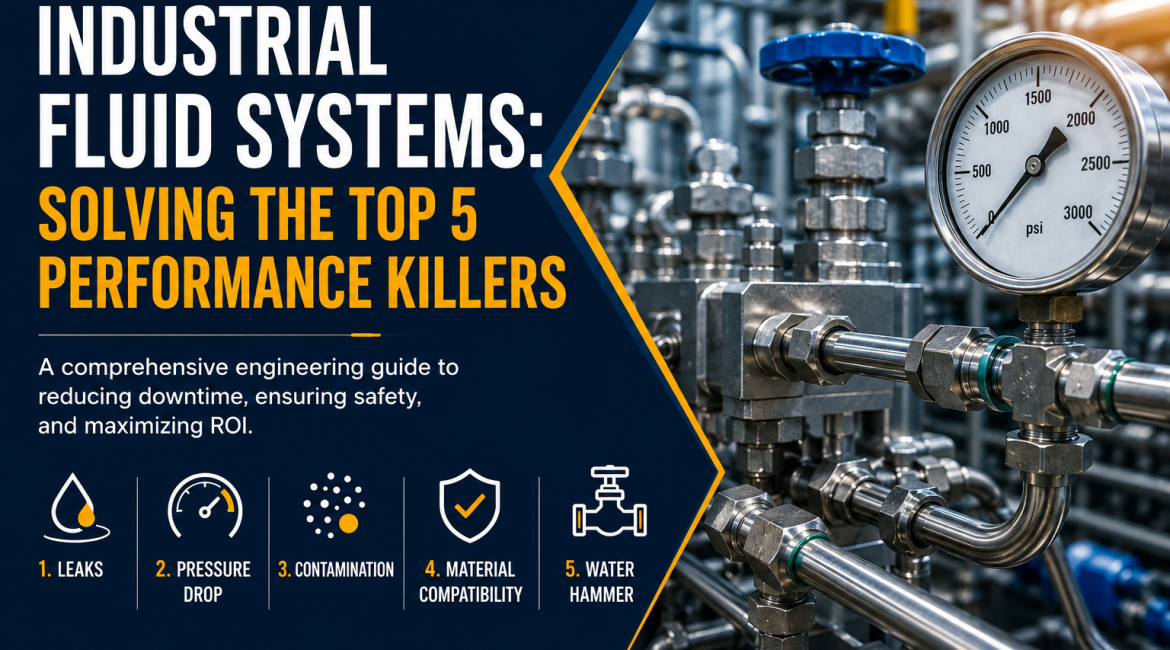
Industrial Fluid Systems: Solving The Top 5 Performance Killers
A comprehensive engineering guide to reducing downtime, ensuring safety, and maximizing ROI in large-scale fluid architecture.
In modern industrial plants, fluid systems are not just plumbing; they are the critical infrastructure that defines your operational efficiency. From chemical processing to high-pressure hydraulics, even a $1\%$ drop in system performance can lead to millions in lost production over time.
1. Chronic System Leakage
Leaks are often dismissed as maintenance nuisances, but they are symptoms of poor connection integrity. A leak of just 1 drop per second results in over 400 gallons of wasted fluid annually.
The Challenge
Threaded connections (NPT) failing under vibration or thermal expansion, causing “weeping” joints.
The Solution
Standardize on Dual-Ferrule Mechanical Grip Fittings. These create a gas-tight seal that is resilient to vibration.
Use gap-inspection gauges during installation to ensure every fitting is torqued exactly to manufacturer specs.
2. Pressure Drop Inefficiency
When your system requires higher pump power to maintain downstream pressure, you are burning energy and wearing out equipment prematurely.
The Challenge
Excessive use of $90^\circ$ elbow fittings and undersized valves creating turbulent flow resistance.
The Solution
Utilize Laminar Flow Routing. Replace elbows with custom-bent tubing and size valves based on Flow Coefficient ($C_v$) rather than pipe size.
3. Particulate Contamination
The Challenge
Microscopic debris scoring valve seats and causing regulator “creep,” leading to system over-pressurization.
The Solution
Integrate Bypass Filtration Systems. This allows for filter changes without shutting down the entire production line.
The Troubleshooting Matrix
| Observation | Root Cause | Engineering Fix |
|---|---|---|
| Audible Hissing | Seal Relaxation | Retorque / Replace with Ferrules |
| Rapid Gauge Pulsation | Water Hammer | Install Surge Suppressors |
| Component Discoloration | Material Fatigue | Upgrade to Exotic Alloys |
4. Material Compatibility & 5. Water Hammer
Material failure often happens silently. Choosing 316 Stainless for a high-chloride environment is a recipe for Stress Corrosion Cracking (SCC). Similarly, high-velocity fluid surges (Water Hammer) can shatter these compromised components.
Install slow-actuating valves to ensure fluid velocity changes happen over 1-2 seconds rather than milliseconds.
Expert Knowledge Base
Why do my fittings leak after a few months of service?
This is usually due to “Thermal Cycling.” As the system heats and cools, metal expands and contracts. NPT threads often back off, whereas dual-ferrule fittings maintain a spring-loaded tension.
Can I mix different brands of tube fittings?
Absolutely not. Tolerances vary by microns between manufacturers. Intermixing leads to unpredictable failure points and voids safety warranties.
Stop Losing Profits to System Failure
Our engineering team at RajGranth provides end-to-end fluid system audits to identify leaks and energy drains before they stop your production.
Schedule Your System Audit