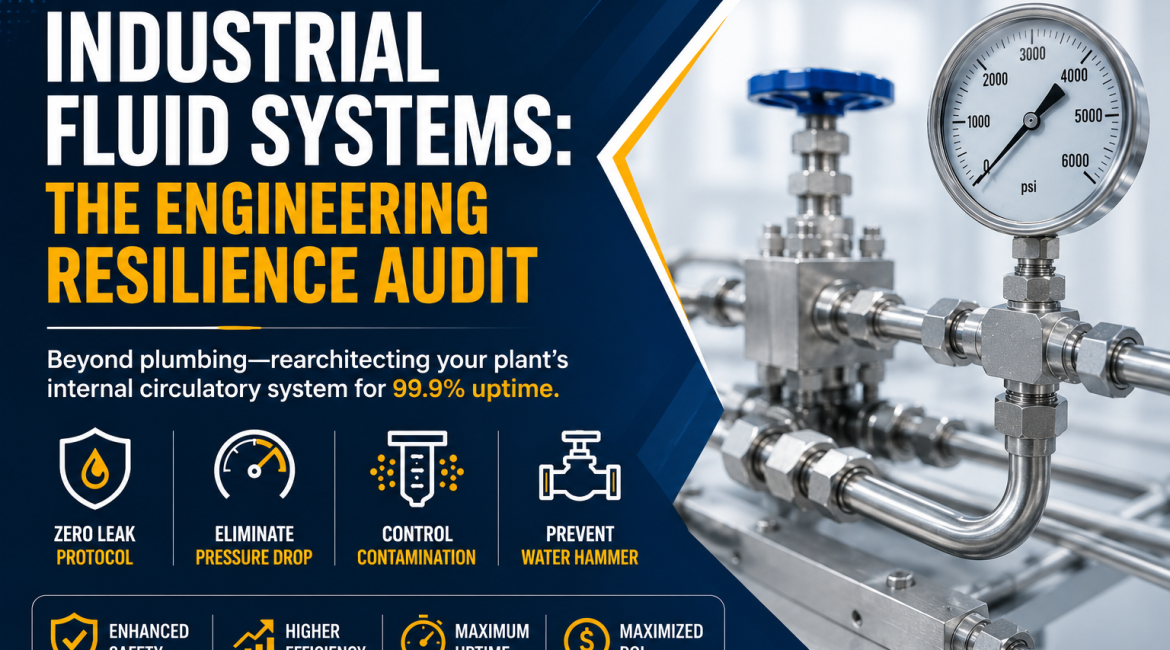
Industrial Fluid Systems: The Engineering Resilience Audit
Beyond plumbing—rearchitecting your plant’s internal circulatory system for 99.9% operational uptime.
The “Circulatory” Philosophy: In the world of high-output manufacturing, we no longer view fluid systems as static pipes. We view them as a nervous system. Just as a single blocked artery can halt a biological organism, a single $1\%$ pressure drop or a microscopic contaminant can paralyze an entire production line. This guide is your diagnostic tool for industrial health.
1. The “Zero Leak” Protocol
In high-pressure gas or volatile chemical environments, a “minor leak” is a myth. Leaks represent a failure in Sealing Logic, typically caused by the relaxation of inferior threaded joints during thermal cycles.
⚠️ THE SYSTEM VULNERABILITY
NPT (Pipe Thread) connections rely on tape or sealant which degrades under vibration, leading to “weeping” that drains energy and compromises safety.
🛡️ THE RESILIENCE FIX
Dual-Ferrule Mechanical Integration: These fittings provide a 100% metal-to-metal seal that utilizes “spring-back” action to survive extreme vibration.
2. Eliminating Hydraulic Friction
Energy efficiency starts with Laminar Flow. When fluid is forced to navigate sharp corners, it creates turbulence—the silent enemy of system pressure.
⚠️ THE SYSTEM VULNERABILITY
Excessive use of elbow fittings creates high-resistance “choke points,” forcing pumps to work $15-20\%$ harder than necessary.
🛡️ THE RESILIENCE FIX
Bent Tubing Architecture: Replace fittings with custom-bent stainless steel tubing. This eliminates leak points and reduces internal friction for maximum pressure delivery.
The Troubleshooting Matrix
| OBSERVATION | ROOT CAUSE DIAGNOSIS | ENGINEERING ACTION |
|---|---|---|
| Sudden Valve Sticking | Particulate Ingress | Install 5-micron Bypass Filtration |
| Pipe “Screaming” / High Noise | Critical Velocity Turbulence | Upsize Tubing / Redesign Bends |
| Component Frosting/Icing | Joule-Thomson Effect | Review Pressure Drop Ratios |
3. Surge Suppression & Compatibility
The most violent moment in a fluid system is a Sudden Valve Closure. The resulting shockwave, or “Water Hammer,” can generate pressure spikes up to $5\times$ the system’s rated capacity.
⚠️ THE SHOCK RISK
Mechanical fatigue from repeated pressure surges leads to microscopic stress cracks, especially in components exposed to corrosive media.
🛡️ THE ARMOR FIX
Surge Dampening & Alloy Mapping: Install pneumatic accumulators to absorb shock and use Alloy 400 or C-276 for parts exposed to high-chloride environments.
Technical Deep-Dive (FAQ)
Why is Flow Coefficient ($C_v$) more important than Pipe Size?
Pipe size tells you how much space you have; $C_v$ tells you how much fluid can actually pass through a valve. An undersized valve on a large pipe creates a bottleneck that destroys efficiency.
What is “Regulator Creep” and how do I stop it?
Creep happens when debris prevents a valve from seating fully, causing downstream pressure to rise. The only fix is upstream high-purity filtration.
Can I reuse ferrule fittings?
Generally, no. Once a ferrule is “set” on a tube, it is permanently deformed to create the seal. Reusing it significantly increases leak probability.
How does temperature affect pressure ratings?
As temperature rises, material strength decreases. A system rated for 6000 PSI at $70^\circ F$ may only safely handle 4000 PSI at $400^\circ F$.
Is Your System Future-Proof?
Don’t wait for a catastrophic failure to audit your fluid architecture. Our RajGranth engineers specialize in “Zero-Downtime” transitions and high-performance component integration.
Request a System Integrity Audit