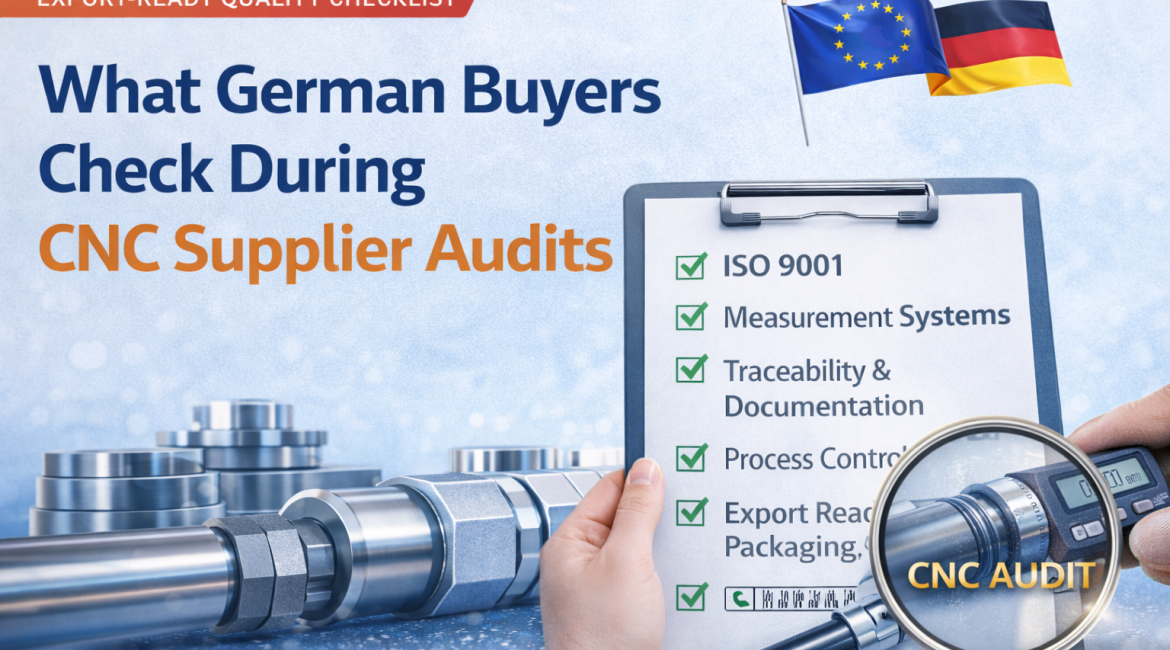
What German Buyers Check During CNC Supplier Audits
For German OEMs, a CNC supplier audit is not a formality. It is a structured evaluation of quality systems, process reliability, documentation, and long-term manufacturing discipline.
German manufacturing is built on precision, repeatability, and accountability. Before approving a CNC machining supplier, German buyers conduct detailed audits to ensure suppliers can consistently meet technical, quality, and export requirements—not just once, but over years of collaboration.
1. Quality Management System & Certification
The first audit checkpoint is the supplier’s quality management system. ISO 9001 certification is typically mandatory, but German buyers also examine how effectively the system is implemented on the shop floor.
- Valid ISO 9001 certification
- Documented procedures and SOPs
- Internal audit and corrective action records
2. CNC Machining Capability & Equipment
German auditors closely review machining capability to verify technical competence and scalability.
- Type and condition of CNC machines
- Capability for tight tolerances
- Experience with stainless steel and engineering alloys
3. Process Control & Repeatability
Repeatability is critical for German OEMs. Auditors check whether machining processes are stable and controlled across batches.
- Defined process parameters
- Tool management and wear control
- In-process inspection records
4. Inspection & Measurement Systems
Measurement capability is evaluated as seriously as machining itself.
- Calibrated measuring instruments
- Surface roughness testing capability
- First Article Inspection (FAI) reports
5. Material Traceability & Documentation
German buyers demand complete traceability from raw material to finished component.
- Heat number tracking
- Batch-wise identification
- EN 10204 – 3.1 material certificates
6. Non-Conformance Handling & Corrective Actions
Auditors assess how suppliers respond to quality issues—not whether issues ever occur.
- Root cause analysis procedures
- Corrective and preventive actions (CAPA)
- Continuous improvement mindset
7. Export Packaging & Logistics Readiness
Export readiness is an essential part of supplier audits for Europe.
- Corrosion protection methods
- Clear labeling and batch identification
- Safe export-grade packaging
FAQs – CNC Supplier Audits in Germany
Do German OEMs conduct on-site audits?
Yes. Many German OEMs prefer on-site audits before approving CNC suppliers.
Is ISO 9001 enough for supplier approval?
ISO 9001 is a minimum requirement, but process implementation matters more.
What is the most critical audit factor?
Process repeatability, traceability, and documentation consistency.
How often are suppliers re-audited?
Approved suppliers may be re-audited periodically or after quality issues.
Preparing for a German CNC Supplier Audit?
Export success in Germany starts with audit readiness and disciplined manufacturing systems.