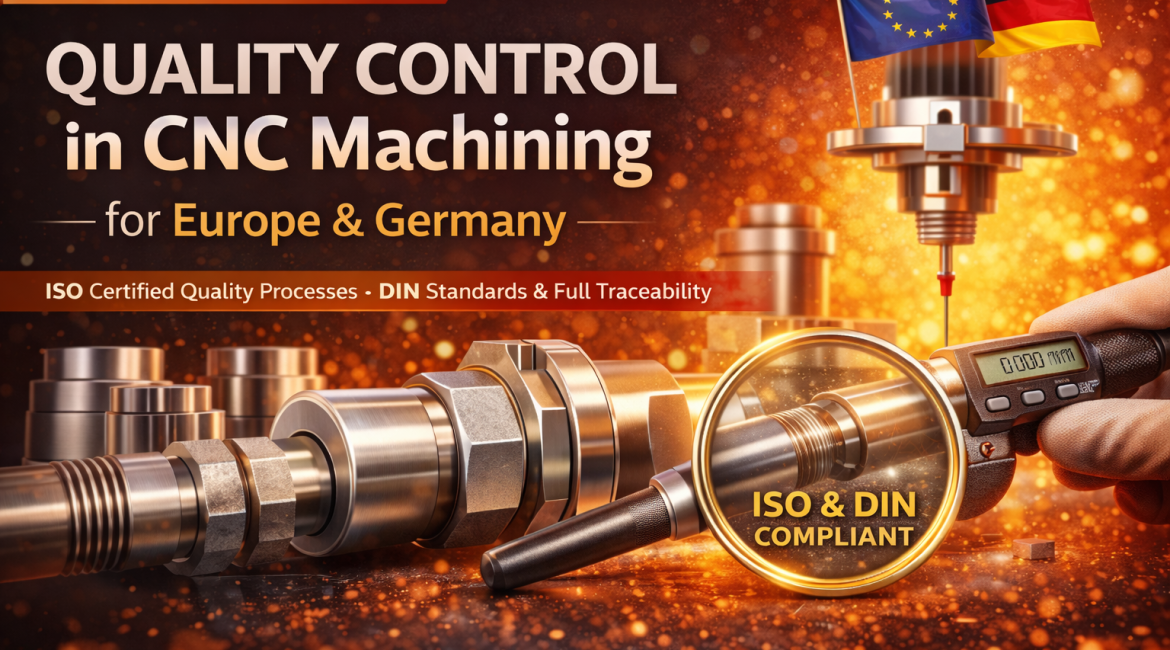
Quality Control Process in CNC Machining for Export Markets (Europe & Germany)
Zero-defect manufacturing, strict documentation, and full traceability — learn how Rajgranth Industries meets European and German CNC machining quality standards.
In European manufacturing markets—especially Germany—quality is not optional. OEMs demand zero-defect CNC machined components, strict documentation, and complete traceability. For components used in pumps, machinery, railways, and industrial equipment, even minor deviations can cause costly failures.
At Rajgranth Industries Pvt. Ltd., quality control is not a final step—it is an integrated process followed throughout CNC machining to meet European and German export standards.
Why Quality Control Is Critical for European & German OEMs
- Tight dimensional tolerances
- Repeatable accuracy across batches
- Compliance with DIN & ISO standards
- Complete inspection records
- Full material traceability
Any CNC supplier exporting to Europe must prove process reliability, not just finished parts.
1. Raw Material Inspection & Traceability
- Material grade and heat number verification
- Batch-wise identification
- Supplier specification checks
Materials: SS 304 / 316 / 316L, Duplex, Super Duplex, alloy steels
EN 10204 – 3.1 Material Test Certificates provided for Europe & Germany.
2. First Article Inspection (FAI)
- Full dimensional inspection of first component
- Drawing verification
- CNC program validation
FAI reports ensure correct setup before full production.
3. In-Process Quality Control
- Interval-based dimensional checks
- Tool wear monitoring
- SPC for repeatability
Maintains tolerances up to ±0.01 mm.
4. Precision Measurement & Inspection
- Micrometers & Vernier calipers
- Bore & height gauges
- Surface roughness testers
- Thread gauges (Go / No-Go)
5. Final Inspection & Documentation
- 100% visual inspection
- Dimensional conformity
- Burr-free & clean components
Inspection reports, MTCs, and traceability records included.
CNC Machining FAQs for Germany & Europe
Do German OEMs require DIN standards?
Yes. Most German companies follow DIN or DIN-aligned ISO standards.
Is ISO 9001 mandatory for CNC exports to Germany?
ISO 9001 is a baseline requirement for most European OEMs.
Are EN 10204 certificates required?
Yes. EN 10204 3.1 certificates are critical for material traceability.
Why do European OEMs source CNC components from India?
Due to cost efficiency, advanced CNC capability, and certified quality systems.
Looking for a Trusted CNC Machining Partner for Europe & Germany?
Rajgranth Industries delivers export-ready CNC machined components with precision and traceability.